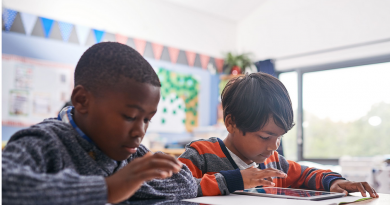
How AI can ensure no student is left behind
Empowering student learning with personalized AI to close achievement gaps, foster engagement and ensure every student has access to tailored educational support, writes Bill Salak.
The US education system didn’t stop working yesterday. In fact, it’s been deeply flawed for a generation. Thirty-five years ago, I was sitting in my high-school classroom, completely disengaged and trying to figure out when I could leave this place. I didn’t know much at 17, but I sure did know that having to memorize useless facts and only train my brain for standardized tests wasn’t working for me. So, I dropped out. 
In the years since dropping out of high school, I’ve come to realize that my experience with the US education system wasn’t unique. A recent survey of 1,039 students conducted by Brainly, an AI learning companion, showed that 72% of students feel “not smart enough” or discouraged by poor grades, and 73% are frustrated by memorizing facts or doing trivial projects with no real-world relevance. Clinging to outdated, one-size-fits-all learning methods that are no longer enough for today’s world is leaving students disengaged and unprepared for the real world. But it doesn’t have to be this way. With the right use of AI, we can boost motivation, personalize learning, and approach true educational equity.
In order to truly learn, students need to be engaged and motivated. Unfortunately, current teaching methods such as memorizing random facts and doing trivial projects are making students feel the exact opposite. When education is focused on memorization instead of meaningful understanding, students often struggle to see the value in what they’re learning. Unfortunately, this disconnect leads to greater disengagement, ultimately stifling a student’s success both while in school and in the workforce.
AI -powered personalized learning is key to engagement
To increase student engagement, we need to personalize a student’s learning experience. While teachers are central to guiding this process, they often lack the bandwidth to create highly personalized lessons for every learner. That’s where AI can step in as a powerful tool.
There are two primary ways to think about using AI in the classroom: teacher-led personalization and student-driven discovery.
Teacher-led personalization
In the teacher-led mode, the teacher uses AI directly to more easily create engaging, personalized materials for different groups of students. An English teacher, for instance, could generate variations of reading comprehension exercises on the same short story — one on discussion prompts to provoke student-group discussions around the story, and one as a gamified quiz for competitive students. Where time and resources were limiting factors to creating multiple meaningful learning-science backed exercises for a single lesson, with AI as a partner, teachers can unlock their creativity and the full potential of their students.
Student-driven discovery
In the student-driven mode, the teacher designs the lesson around students using AI as an active learning tool. A history teacher might present a challenge to the class: “I’m going to give you statements about the Civil War. Use AI to investigate which ones are true and find the evidence, and which ones are false and how you determined that.” This shifts AI from a behind-the-scenes resource into a hands-on partner, helping students develop critical thinking, research skills, deeper engagement with the content, and ultimately deeper understanding and retention of the lesson.
These are small, concrete steps that can be implemented right now, not abstract promises for the future. And because they meet students where they are, adapt to their needs and open access to resources that were once out of reach, they move us closer to an education system that truly engages every learner and narrows long-standing equity gaps.
Closing education’s equity gap is essential
The US education system has long been stained by inequality, a divide between the haves and have-nots. Access to vital educational resources, such as textbooks and tutors, all come with a price tag, often a price tag that many people can’t afford. This leaves a majority of students with little to no resources to be able to succeed, especially with state-organized standardized tests and college applications.
While full education equity can’t be solved overnight, AI can help us get there quicker than anything else. For instance, AI can help open access to critical resources, such as offering guidance on college applications, writing support, personalized note-taking and test preparation. At the advent of social media, the promise was to democratize access to people and relationships. More than two decades later, it’s time to fulfill this promise for our education system.
While reviewing important battles of the US Civil War, I eagerly raise my hand, arguing that the Battle of Monocacy is one of the most underrated battles of the Civil War. The teacher engages my comment, and we break out into a deeper discussion. Sadly, this won’t ever be my reality but it can be the reality for a new generation of students. We are now equipped with technology we could have only dreamed of during my high school years. While uncomfortable or unfamiliar at first, teachers and administrators are on the precipice of an incredible opportunity to engage and teach students like never before. By integrating AI-driven approaches that boost motivation, personalize learning and approach true educational equity, we can make sure that no student is left behind.
Source:https://www.smartbrief.com/original/how-ai-can-ensure-no-student-is-left-behind?utm_term=AEE6C64D-A551-4448-AC86-73E9EA97DDFE&lrh=286d9352d62fd57e4fed3250c88b0f8daf660a6cf28a1a542f1b6f7d4db58c17&utm_campaign=AC59823B-4C3C-4F57-8D2A-7EDD2B31AA42&utm_content=DFE9E15C-9D06-4B45-91A0-992AFA89B5A4&utm_source=brief